Why More Pruning Isn’t Always the Answer for a Heat-Stressed Tree
August in North Texas can be brutal on trees.
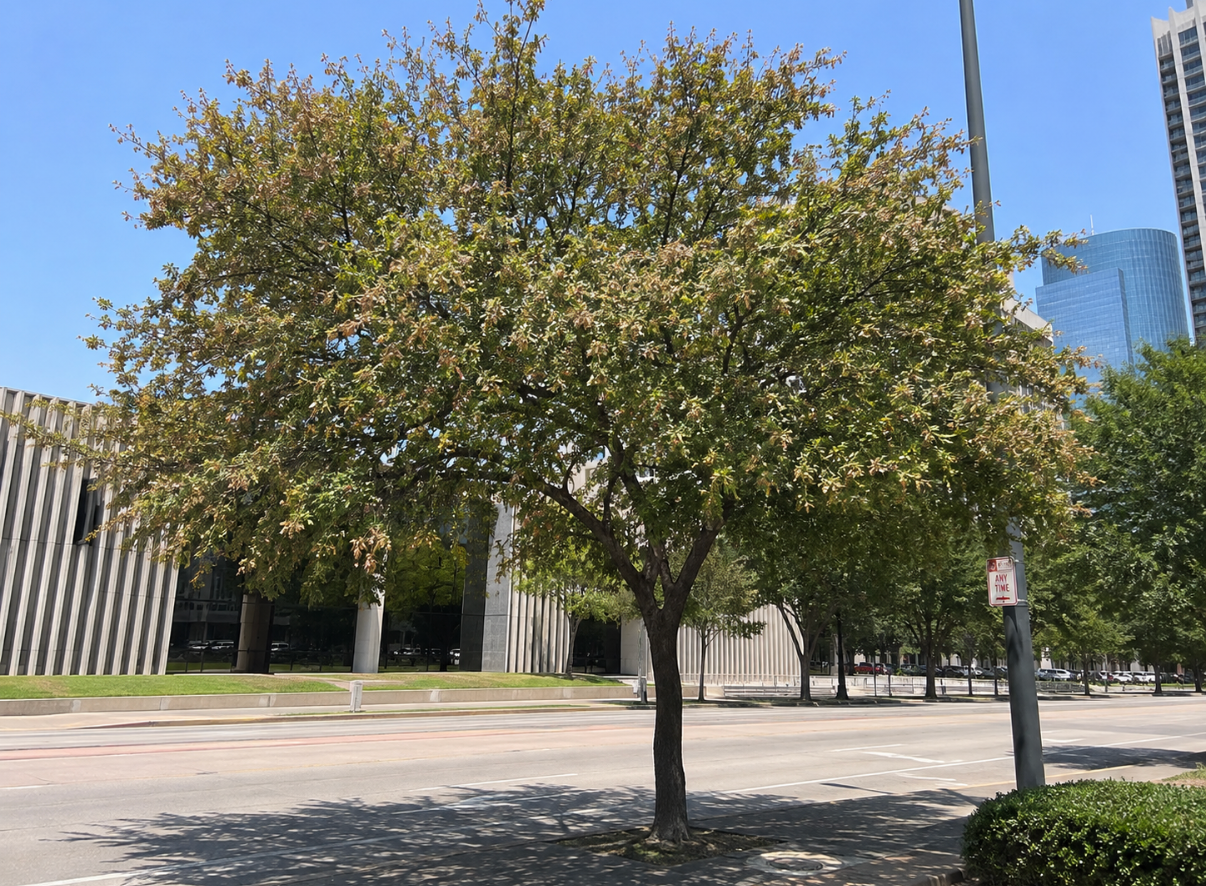
Weeks of intense sun, high temperatures, warm nighttime conditions, and limited rainfall can put tremendous stress on trees growing in urban and commercial landscapes. By late summer, some of that stress can become visible in the canopy.
Browning or scorched leaves. Wilting. Thinning foliage. Premature leaf drop.
When a tree starts looking rough, the natural reaction may be to clean it up. Remove some branches. Thin the canopy. Make the tree look better.
But that may be exactly the wrong place to start.
A Stressed Canopy Is a Symptom, Not a Diagnosis
One of the most important things to understand about tree care is that what we see in the canopy is often only part of the story.
Discolored leaves, dead branches, and early leaf drop can indicate that a tree is experiencing a problem, but there can be multiple underlying causes. The International Society of Arboriculture recommends evaluating tree symptoms and identifying the underlying issue rather than treating appearance alone.
North Texas summer conditions can certainly contribute to stress. Drought, extreme temperatures, soil conditions, root problems, irrigation issues, insects, disease, and other environmental factors can also play a role. Texas A&M AgriLife Extension identifies drought and temperature extremes among the environmental stresses that can weaken trees.
That is why our first question is not:
It is:
Why Over-Thinning Can Create Another Problem
A tree’s canopy is not just there for appearance.
Leaves are the tree’s energy-producing system. They capture sunlight and use photosynthesis to manufacture the carbohydrates the tree needs for growth, maintenance, defense, and recovery.
The canopy also provides shade to the tree’s trunk and branches.
When too much live foliage is removed, especially from a tree that is already under environmental stress, we are taking away part of the system the tree relies on to function.
Pruning is an important part of proper tree management, but every cut should have a reason.
The International Society of Arboriculture explains that pruning cuts can affect the future growth of a tree and that improper pruning can cause lasting damage. Heavy removal of living tissue can be particularly problematic when a tree is already weak or stressed.
This is where the difference between pruning a tree and managing a tree becomes important.
Pruning Should Have an Objective
Good pruning is not about creating the thinnest canopy or the cleanest silhouette.
It starts with an objective.
There may be dead, damaged, diseased, weakly attached, or structurally compromised branches that should be addressed. A tree may require clearance from a building, roadway, sidewalk, lighting, or other infrastructure. Certain branches may need to be managed to improve structure or reduce risk.
Those are specific reasons to prune.
The ANSI A300 Tree Care Standards provide industry guidance for professional tree-care practices, including establishing pruning objectives based on tree health, structure, risk, clearance, and other management needs.
What Should We Look at Before Making a Cut?
When a tree is showing signs of summer stress, the canopy is only one part of the evaluation.
We also want to understand what is happening around and below the tree.
- Has the tree been receiving adequate water?
- Has irrigation recently changed?
- Is the root zone surrounded by pavement or reflected heat?
- Has construction disturbed the surrounding area?
- Is the soil compacted?
- Are there signs of insects or disease?
- Are certain branches actually dead or structurally compromised?
- Could the tree be responding to temporary environmental stress?
Trees in urban environments can face several stresses simultaneously. Soil, water, surrounding vegetation, construction, and maintenance practices can all influence tree health.
The ISA’s Plant Health Care guidance emphasizes evaluating the entire landscape and identifying the underlying cause of abnormal symptoms before selecting a treatment.
That is why a proper assessment matters.
Sometimes the Best Pruning Decision Is to Prune Less
There are certainly situations where pruning during summer is appropriate.
Dead or hazardous limbs may need attention regardless of the season. Structural problems may create a risk that should not simply be ignored. Targeted pruning may be appropriate when there is a clear objective.
But a stressed tree should not automatically receive aggressive canopy thinning simply because it looks bad.
Sometimes the better recommendation is targeted pruning.
Sometimes it is improving irrigation.
Sometimes it is addressing soil or root-zone conditions.
Sometimes it is monitoring the tree.
And sometimes the best pruning recommendation is simply:
Assess. Diagnose. Educate. Execute.
At Plano Tree Care, we believe the work should begin before the first cut is made.
We assess the tree and its surroundings.
We diagnose what may be contributing to the problem.
We educate the property owner or manager about what we are seeing and why it matters.
Then we execute the appropriate tree-care plan based on the condition of the tree, its structure, the property, and the objective of the work.
That approach becomes especially important during a North Texas summer, when trees may already be working hard to manage environmental stress.
A cleaner-looking canopy is not necessarily a healthier canopy.
Concerned About a Tree on Your Property?
If a tree is showing signs of heat stress, thinning foliage, premature leaf drop, or declining branches, the first step is understanding what is causing the problem.
Plano Tree Care has served North Texas for more than 30 years, providing professional tree care for residential and commercial properties.
Learn More About Plano Tree Care