
Your Tree Is Running Two Engines, Not One
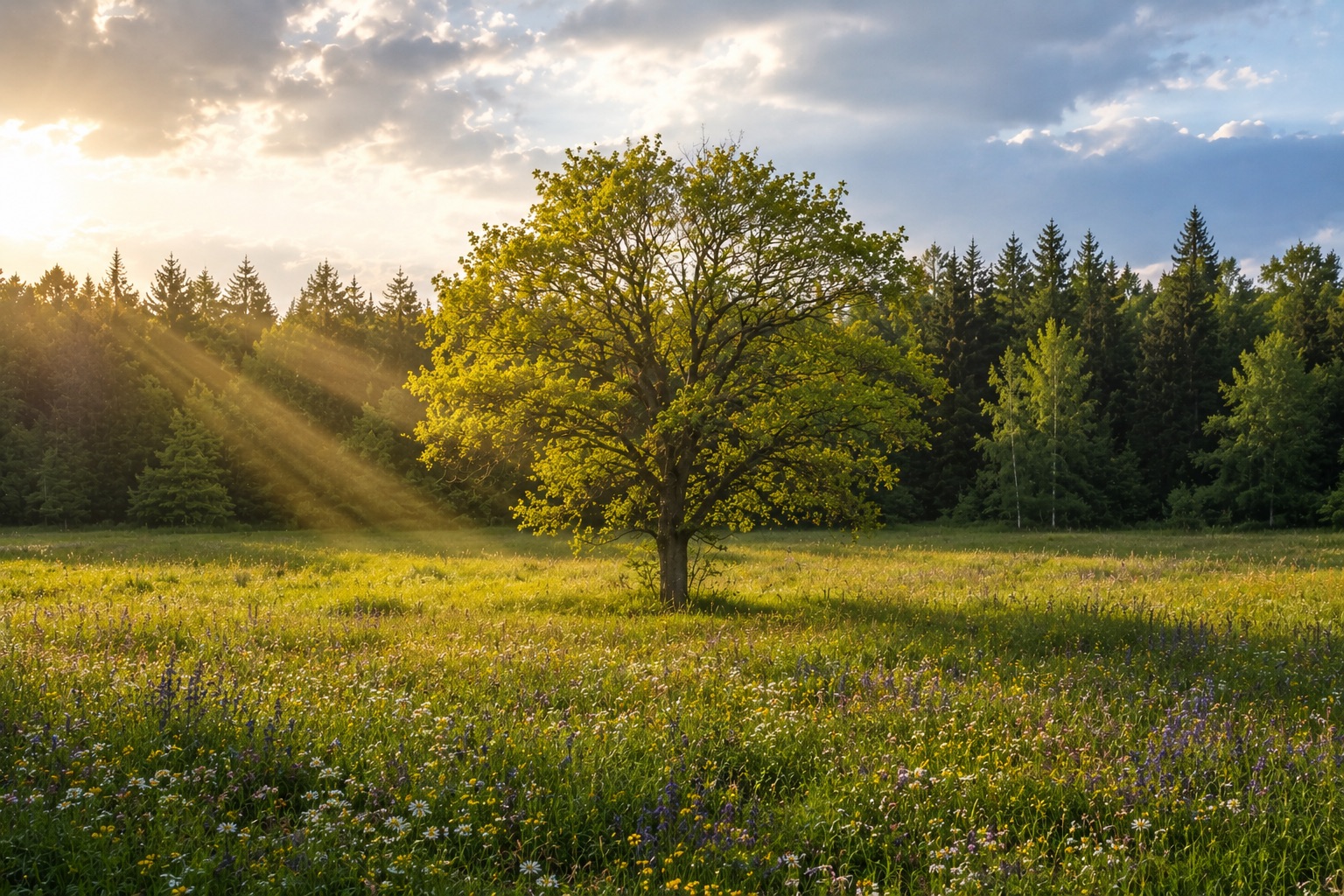
A full canopy of green leaves usually looks like a sign of a healthy tree. And in many cases, it is.
But what we see above ground tells only part of the story.
A tree can continue producing leaves and capturing sunlight while problems are developing in the root zone below it. Soil compaction, root damage, poor drainage, limited rooting space and construction activity can interfere with the environment a tree needs to function properly.[4][5]
To understand why, it helps to think about two processes taking place inside a living tree: photosynthesis and respiration.[1][2]
Think of them as two parts of the tree's energy system.
Engine #1: Photosynthesis Produces the Tree's Fuel
Photosynthesis is the part most people remember from science class.
Leaves use sunlight to help convert carbon dioxide and water into chemical compounds, including sugars. Those sugars provide carbon and stored chemical energy that can ultimately be used throughout the tree.[1]
In simple terms, the canopy is helping manufacture the tree's fuel.
But making that fuel is only part of the process.
The tree still has to put it to work.
Engine #2: Respiration Helps Put That Energy to Work
Trees also undergo cellular respiration, a process through which stored chemical energy becomes available for growth, maintenance and other metabolic activity.[2]
Unlike photosynthesis, which depends on light, respiration continues throughout the day and night. The U.S. Forest Service notes that tree respiration continues throughout the 24-hour cycle.[2]
Carbon produced through photosynthesis can be allocated throughout a woody plant for functions including growth, storage, maintenance, defense and responses to injury.[3]
That means tree health is about more than whether sunlight is reaching the leaves. The entire tree has to function as a connected biological system.[2][3]
A Green Canopy Doesn't Always Tell the Whole Story
This is where evaluating tree health becomes more complicated.
A tree may still have a green canopy while conditions around its roots are becoming less favorable. In urban environments, soil compaction is a significant concern because it can reduce pore space, restrict root growth and decrease the amount of oxygen available in the soil.[4]
The U.S. Forest Service has identified soil compaction as an important constraint on urban tree health, noting that compacted soil can create physical barriers to root growth and reduce oxygen as larger soil pore spaces are lost.[4]
Roots are not simply anchors holding a tree in the ground. They are living tissues that depend on a suitable soil environment, including appropriate access to water, oxygen and rooting space.[4]
What Happens Below Ground Matters Above Ground
Problems in the root zone can develop for many reasons.
Construction is one example. The Texas A&M Forest Service explains that construction-related tree damage can result from compacted soil, changes in soil grade, and physical damage to tree roots.[5]
Driveways, sidewalks, buildings, equipment traffic and changes to the surrounding landscape can alter the environment in which tree roots are trying to grow.[4][5]
This can be especially important in developed residential and commercial landscapes, where available rooting space and soil conditions may differ significantly from those found in an undisturbed natural setting.[4]
North Texas Adds Another Layer of Stress
Trees in North Texas can face combinations of intense summer heat, periods of drought and difficult urban growing conditions.
Plano Tree Care discusses these regional challenges in our article, How North Texas Weather Affects Tree Health and What You Can Do About It , including the effects of heat, drought and environmental stress on local trees.[6]
During hot and dry periods, water management around the root zone becomes particularly important. Our Texas Summer Tree Care Guide provides additional information about heat stress, watering and protecting North Texas trees during extended summer conditions.[7]
Tree Decline Often Starts Before It Becomes Obvious
One of the challenges with tree health is that decline does not necessarily happen all at once.
Trees can experience cumulative stress from soil conditions, root disturbance, weather, insects, disease and other environmental pressures. Because several factors can be involved at the same time, evaluating only whether the canopy is currently green can provide an incomplete picture of overall tree condition.[4][5]
Plano Tree Care's Plant Health Care program is designed around looking at the tree, its growing environment and the factors that may be affecting long-term vitality, rather than assuming every tree requires the same treatment.[8]
Plant Health Care Looks at the Entire System
When we evaluate a tree, the question isn't simply:
“Are the leaves green?”
We also want to understand what is happening throughout the tree's growing environment.
Depending on the situation, that evaluation may include:
- Canopy condition and growth
- Visible signs of stress or decline
- The root zone and surrounding soil conditions
- Drainage and irrigation patterns
- Soil compaction
- Construction or root disturbance
- Insect activity
- Signs of disease
- Heat and drought stress
- Changes to the surrounding landscape
Looking at these conditions can help identify potential sources of tree stress before deciding whether treatment or corrective work is appropriate.[4][5][8]
The purpose is not to assume that every tree needs fertilizer, insect treatment or another intervention.
The first job is to understand what may actually be affecting the tree.
Assess. Diagnose. Educate. Execute.
At Plano Tree Care, our approach to tree health follows a straightforward process.
Assess
Look at the entire tree, the root environment and the conditions surrounding the property.
Diagnose
Determine whether the symptoms may be related to environmental stress, soil conditions, root problems, insects, disease or another factor.
Educate
Explain what we are seeing, why it matters and what options are available.
Execute
When corrective work or treatment is appropriate, develop a plan based on what the tree and property actually need.
Because responsible tree care shouldn't begin with a treatment.
It should begin with understanding the problem.
Healthy Trees Start Below the Surface
Leaves are the most visible part of a tree, but they are only one part of a much larger biological system.
Photosynthesis creates sugars that store chemical energy. Respiration and other metabolic processes make that energy available to living tissues, while roots continue functioning within the soil environment below the surface.[1][2][4]
When those systems are functioning together, a tree is better equipped to grow, maintain living tissue and respond to environmental stress.[2][3]
When soil conditions, root damage or other stresses interfere with those processes, visible symptoms above ground may not tell the entire story.[4][5]
So the next time you look at a big green canopy, remember:
The part of the tree you can see isn't necessarily where the whole story is taking place.
Concerned About the Health of a Tree?
If a tree on your property isn't growing normally, has begun thinning, is showing unusual leaf symptoms, or you're concerned about what may be happening below ground, Plano Tree Care can help evaluate the situation.
Learn more about our Plant Health Care services or request an evaluation.
Plano Tree Care has served Plano and North Texas for more than 30 years and provides professional tree care with ISA Certified Arborist expertise.[9]
Sources & Additional Reading
The tree biology and tree-health information in this article was developed using forestry, arboriculture and regional tree-care resources, including the U.S. Department of Agriculture, U.S. Forest Service and Texas A&M Forest Service.
- U.S. Department of Agriculture / U.S. Forest Service. “The Power of One Tree: The Very Air We Breathe.” Provides background on photosynthesis and the production of sugars using sunlight, carbon dioxide and water. View USDA Source
- U.S. Forest Service, Southern Research Station. “The Tree and Its Environment.” Discusses photosynthesis, respiration, temperature and the continuous nature of respiration. View U.S. Forest Service Source
- U.S. Forest Service. “Carbon Allocation to Roots and Shoot Systems of Woody Plants.” Discusses the allocation of carbon among plant organs and functions including growth, maintenance, defense, injury response and storage. View U.S. Forest Service Research
- U.S. Forest Service Research and Development. “A Rapid Urban Site Index for Assessing the Quality of Street Tree Planting Sites.” Discusses soil compaction as a constraint on urban tree health and its effects on root growth, soil pore space and oxygen availability. View U.S. Forest Service Research
- Texas A&M Forest Service. “Protect Tree Roots During Construction.” Provides guidance on construction-related tree damage, including compacted soil, alterations to soil grade and damage to tree roots. View Texas A&M Forest Service Source
- Plano Tree Care Inc. “How North Texas Weather Affects Tree Health and What You Can Do About It.” Regional information on weather-related stress affecting trees in North Texas. Read the Plano Tree Care Article
- Plano Tree Care Inc. “Texas Summer Tree Care.” Information about summer heat stress, watering and protecting trees during North Texas summers. Read the Plano Tree Care Article
- Plano Tree Care Inc. “Plant Health Care.” Information about Plano Tree Care's approach to Plant Health Care and evaluating factors affecting tree health. Learn About Plant Health Care
- Plano Tree Care Inc. Company information regarding professional tree-care services, ISA Certified Arborist expertise and more than 30 years serving Plano and North Texas. Visit Plano Tree Care