Why Are My Tree Leaves Turning Yellow? Understanding Chlorosis in North Texas
Not every yellow tree is dying. But not every yellow tree is fine either. In North Texas, the pattern of yellowing can tell us a great deal about what may be happening inside the tree and below the soil.
When homeowners see leaves beginning to yellow, drought stress, extreme heat, disease or general decline may immediately come to mind. Those are all possibilities. But another common cause is chlorosis, a condition associated with a reduction in the chlorophyll that normally gives leaves their green color.
In many Texas landscapes, the issue is not necessarily that iron is missing from the soil. Instead, alkaline soil conditions can make iron less available for the tree to absorb. Texas A&M AgriLife Extension identifies iron as one of the micronutrients commonly deficient in alkaline Texas soils and notes that some red oaks are among the trees that can be affected.
What Does Chlorosis Look Like?
One of the most important parts of evaluating a yellowing tree is looking at how the leaf is turning yellow.
With iron chlorosis, the leaf tissue between the veins often becomes pale green or yellow while the veins remain noticeably greener. This pattern is known as interveinal chlorosis.
The pattern frequently becomes most noticeable on new growth or toward the ends of branches. Both the Morton Arboretum and university extension diagnostic resources describe green veins surrounded by yellowing leaf tissue as a characteristic symptom of iron-related chlorosis.
That does not mean every leaf with this appearance automatically has chlorosis. Drought, root damage, poor drainage, compaction, disease and other stresses can also cause discoloration or decline.
That is why the first step should be diagnosis rather than simply adding water or fertilizer.
Why Is Chlorosis a Concern in North Texas?
Soil pH has a direct effect on nutrient availability.
Many North Texas soils are alkaline, and Texas A&M notes that lowering soil pH in alkaline areas of North Texas can be difficult. Iron may already exist in the soil, but high pH can change it into forms that roots have difficulty absorbing.
In other words, the nutrient may be present without being readily available to the tree.
Iron plays an important role in chlorophyll formation and normal photosynthesis. When the tree cannot access enough available iron, the familiar yellow-and-green leaf pattern may develop.
Are Some Trees More Susceptible?
Yes. Tree species differ significantly in how well they tolerate alkaline soil.
Pin oak is a well-documented example. It prefers more acidic soil conditions and can develop significant chlorosis when planted in alkaline soil. The Morton Arboretum's pin oak guidance specifically identifies high soil pH as a serious chlorosis problem for the species.
Texas A&M also identifies some red oaks among the plants that may experience iron deficiency when they are not well adapted to alkaline soil.
This is an important distinction. We should not assume that every oak has the same soil requirements or the same susceptibility. Species matters.
Start the Diagnosis With the Newest Growth
If you are trying to understand why a tree is yellowing, begin by slowing down and observing the pattern.
- Are the newest leaves noticeably lighter than older leaves?
- Is the tissue between the veins yellow while the veins remain green?
- Is the yellowing concentrated toward branch tips or new growth?
- Are nearby trees of different species remaining green?
- Has watering changed recently?
- Has the root zone been disturbed, compacted or repeatedly saturated?
Those clues can help narrow the possibilities, but leaf color alone does not provide a complete diagnosis.
Texas A&M Forest Service's TreeMD diagnostic resource also emphasizes that tree symptoms can have multiple causes and that an experienced arborist or forester may be needed when the cause is uncertain.
Can Chlorosis Be Treated?
In many cases, chlorosis can be managed, but there is not a single treatment that is correct for every tree or every property.
Soil and Site Evaluation
Soil pH, drainage, compaction, irrigation and root-zone conditions should be considered before deciding how to respond.
Soil modification or acidification may sometimes be part of a management strategy, but alkaline North Texas soils can strongly resist changes in pH. That makes soil testing and site-specific recommendations especially important.
Chelated Iron
Chelated iron treatments can help make iron more available under certain conditions. Texas A&M AgriLife Extension discusses the use of iron chelates for plants experiencing iron deficiency in alkaline soil.
The product and application method matter because different forms of iron behave differently at different soil pH levels. Applying a generic fertilizer without understanding the underlying problem may not correct the deficiency.
Look Beyond the Leaf
A yellow leaf does not exist in isolation.
A proper evaluation may also consider irrigation, drainage, root damage, planting depth, soil compaction, construction disturbance and other stresses that could be affecting the tree.
Plano Tree Care's Plant Health Care services focus on evaluating the condition of the tree and property before determining what treatment, if any, makes sense.
Sometimes the Real Problem Started at Planting
One of the most important lessons chlorosis teaches us is that tree health begins before the tree goes into the ground.
A species that naturally prefers acidic soil may require ongoing intervention when planted in a highly alkaline location.
That can create a cycle in which symptoms are treated repeatedly while the underlying incompatibility between the tree and its site remains.
Before planting, consider:
- Soil pH
- Drainage
- Available root space
- Sun exposure
- Mature canopy size
- Water requirements
- Heat tolerance
- The species' compatibility with North Texas soil conditions
Plano Tree Care's North Texas tree planting service includes site and soil evaluation and species recommendations because choosing the right tree for the location can help prevent problems long before treatment becomes necessary.
What a Healthy Canopy Can Tell Us
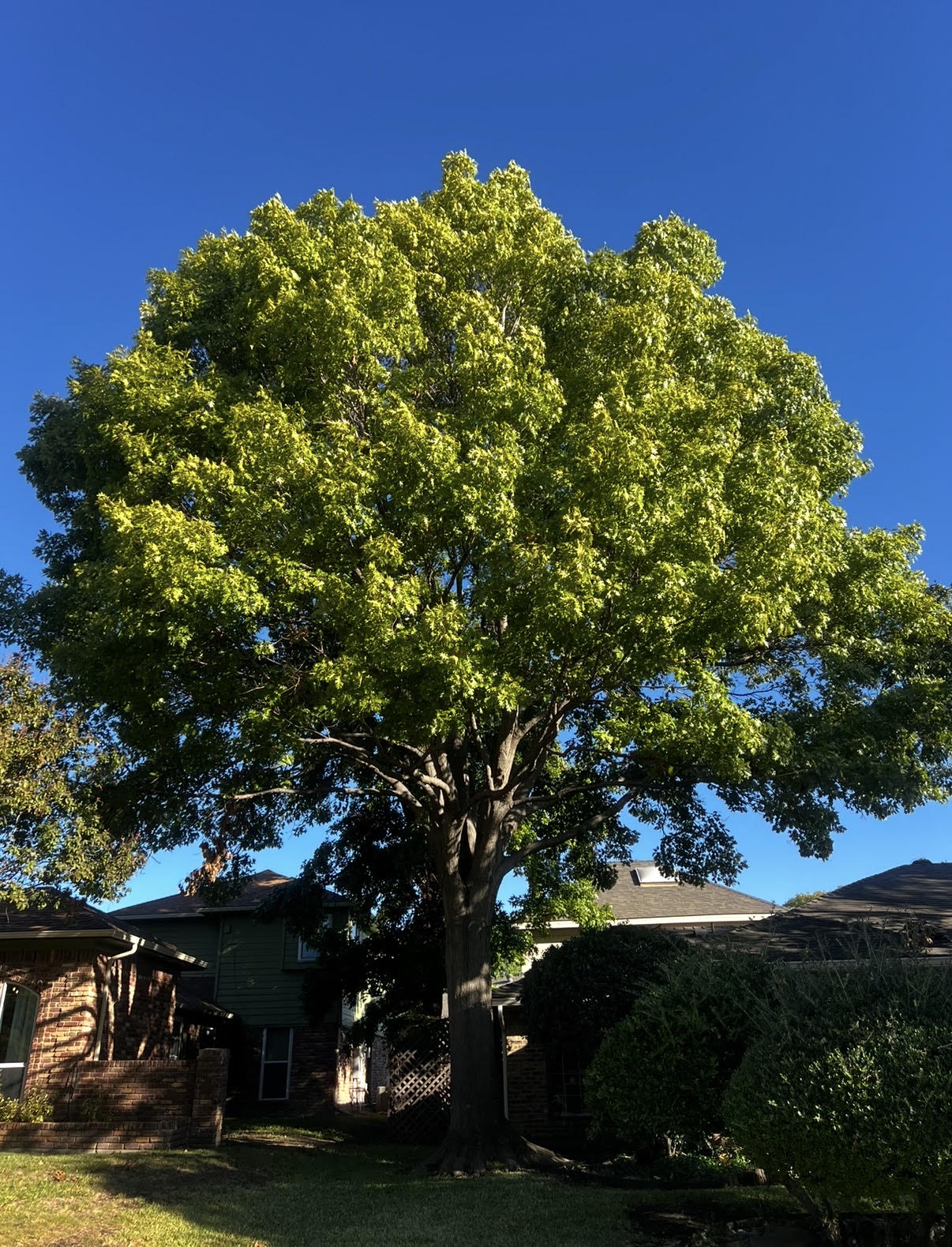
The mature tree pictured above has the kind of full canopy we want to see.
A healthy-looking canopy does not prove that every condition below ground is perfect, but it is one visible part of the overall health picture. Tree health is the result of many interacting factors, including species, soil, roots, available nutrients, water and long-term maintenance.
When a canopy begins changing color unexpectedly, the goal should not simply be to make the leaves green again.
The goal is to understand why the tree changed in the first place.
The Bottom Line
Not every yellow tree is dying.
But yellowing should not automatically be dismissed as heat or drought stress either.
In North Texas, chlorosis should be considered when newer leaves develop yellow tissue between distinctly green veins, particularly on species known to struggle in alkaline soil.
Treatment may involve improving site conditions, addressing other stresses or using an appropriate iron treatment. In some situations, however, the larger lesson is that the tree species and the planting site were never an ideal match.
Sources & Further Reading
- Texas A&M AgriLife Extension: Fertilizing Woody Ornamentals — iron deficiency, alkaline Texas soils and susceptible species.
- Texas A&M AgriLife Extension: My Tree Looks Bad, What Is Going On? — chlorosis symptoms, susceptible species and iron chelate treatment.
- The Morton Arboretum: Chlorosis — interveinal chlorosis, nutrient availability and soil pH.
- Texas A&M Forest Service: TreeMD — tree symptom diagnosis and additional tree-health resources.
Seeing Yellow Leaves on a North Texas Tree?
Before treating the symptom, find out what is causing it. Plano Tree Care can evaluate the tree, root zone and site conditions and help determine the appropriate next step.
Request a Tree Evaluation