When One Side of a Tree Starts Dying: What Property Managers Should Know
A tree does not have to be completely dead to become a concern. Sometimes, the warning signs appear on just one side of the canopy.
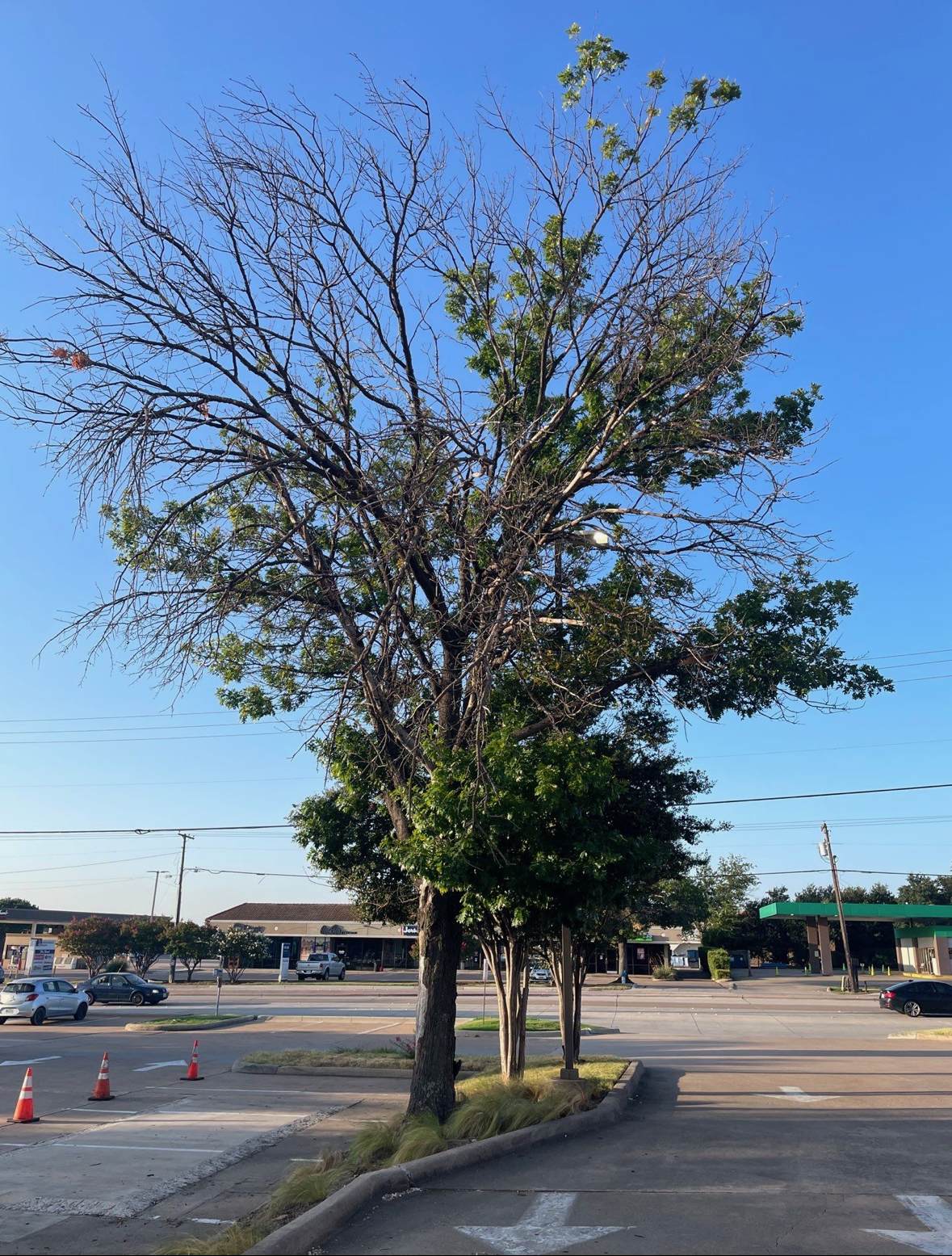
We recently evaluated a tree located in a commercial parking lot median that showed exactly that kind of decline. One side of the tree contained significant deadwood while the remaining canopy was holding onto patchy green growth.
From a distance, it was already clear that something was wrong.
What One-Sided Dieback Can Tell Us
When a significant portion of a tree begins declining while the rest of the canopy remains alive, it may indicate that the tree is experiencing stress or damage that deserves further investigation.
Contributing factors can include root damage, soil compaction, drainage changes, previous construction activity, disease, environmental stress, or a combination of conditions. The International Society of Arboriculture notes that construction-related impacts such as severed roots, soil compaction, grade changes, drainage changes, and physical injuries can affect tree health and stability.
That is why the canopy is only one part of the evaluation.
A tree assessment may consider:
- Root zone conditions
- Trunk condition
- Structural defects
- Dead or declining branches
- Canopy density
- Signs of disease or decay
- The surrounding environment
- Nearby people, vehicles, buildings, walkways, and traffic areas
The goal is not simply to determine whether a tree looks unhealthy. The goal is to understand what the tree is telling us and determine what action, if any, may be appropriate.
Why Location Matters
This particular tree was growing in a commercial parking lot median.
That matters.
A declining tree located far away from people or property can present a very different situation from a declining tree positioned near parking spaces, sidewalks, drive lanes, entrances, buildings, or other frequently used areas.
In this case, more than half of the live crown had already been lost, and the remaining structure was positioned near an active drive lane and parking area.
That combination increased the concern.
Professional tree-risk assessment considers more than the condition of the tree itself. The potential for a tree or branch to impact a nearby target, such as a person, vehicle, building, or other property, is also an important part of evaluating risk. The ISA Basic Tree Risk Assessment guidance specifically incorporates targets, likelihood of impact, and potential consequences into the assessment process.
On commercial properties, those potential targets may include:
- Customers
- Employees
- Vehicles
- Pedestrians
- Buildings
- Signs and lighting
- Utility areas
- High-traffic entrances and exits
This is one reason routine tree inspections can be an important part of commercial property tree care .
It should begin with an assessment.
Why Removal Was the Right Decision
After evaluating the root zone, trunk, canopy, and surrounding area, we walked the property manager through what we were seeing.
With substantial one-sided dieback, significant crown loss, and the tree positioned near active parking and traffic areas, commercial tree removal was the appropriate decision for this particular situation.
The important part of the process was not simply removing the tree.
It was helping the property manager understand why the recommendation was being made.
Not every tree showing decline needs to be removed. Depending on the tree, the defect, the surrounding targets, and the overall condition of the site, other management options may be available. ISA guidance includes possible risk-management approaches such as pruning, routine care, structural support where appropriate, modifying potential targets, or removal when warranted.
What About the Trees Around It?
When one tree on a property experiences significant decline, the conversation should not necessarily end when that tree comes down.
The surrounding trees should also be considered.
If soil conditions, drainage, construction damage, irrigation issues, root disturbance, or other environmental stresses contributed to the decline, neighboring trees may be experiencing some of the same conditions.
That is why we also discussed a plan for monitoring and protecting the trees surrounding this location.
Finding problems early can give property managers more options.
In some situations, corrective pruning, soil improvements, irrigation adjustments, plant health care , or ongoing monitoring may help address problems before decline becomes severe.
Trees Often Give Warning Signs
Trees rarely send an email when something is wrong.
They communicate through changes in their structure and appearance.
The International Society of Arboriculture identifies a number of conditions that may warrant additional evaluation, including dead branches, cracks or splits, signs of decay, cavities, root problems, wounds, and damage related to construction or other human activity.
Warning signs worth paying attention to can include:
- Increasing deadwood
- A thinning canopy
- One-sided decline
- Large dead or hanging limbs
- Cracks or cavities
- Fungal fruiting bodies
- Visible root damage or soil movement
- Changes in the tree's lean
- Changes in leaf size, density, or color
- Sections of the canopy failing to leaf out normally
Not every warning sign means a tree needs to be removed.
But those changes are worth investigating.
According to ISA guidance, monitoring trees can help identify developing issues, while professional assessment can help determine the significance of defects and possible management options.
Assess Before You Act
Commercial tree care is not just about reacting after a limb falls or a tree fails.
It is about recognizing problems early, understanding the condition of the tree, evaluating the surrounding environment, and making informed decisions.
Understand what is happening.
Explain the options.
Then determine the appropriate action.
Trees often show warning signs before they fail.
The key is recognizing them early.
Managing Trees on a Commercial Property?
Plano Tree Care Inc. works with property managers, facilities teams, HOAs, retail properties, office campuses, healthcare facilities, schools, and other commercial properties throughout North Texas.
Explore Commercial Tree Care Commercial Tree RemovalSources & Further Reading
International Society of Arboriculture: Managing Hazards and Risk
International Society of Arboriculture: Recognizing Tree Risk
International Society of Arboriculture: ISA Basic Tree Risk Assessment Form Instructions