
Tree Health & Plant Health Care | North Texas
Mistletoe in North Texas Trees: When Is It a Problem and What Should You Do?
Mistletoe gets plenty of attention during the holidays. But when those green clusters appear in your trees, what do they mean for the tree's long-term health?
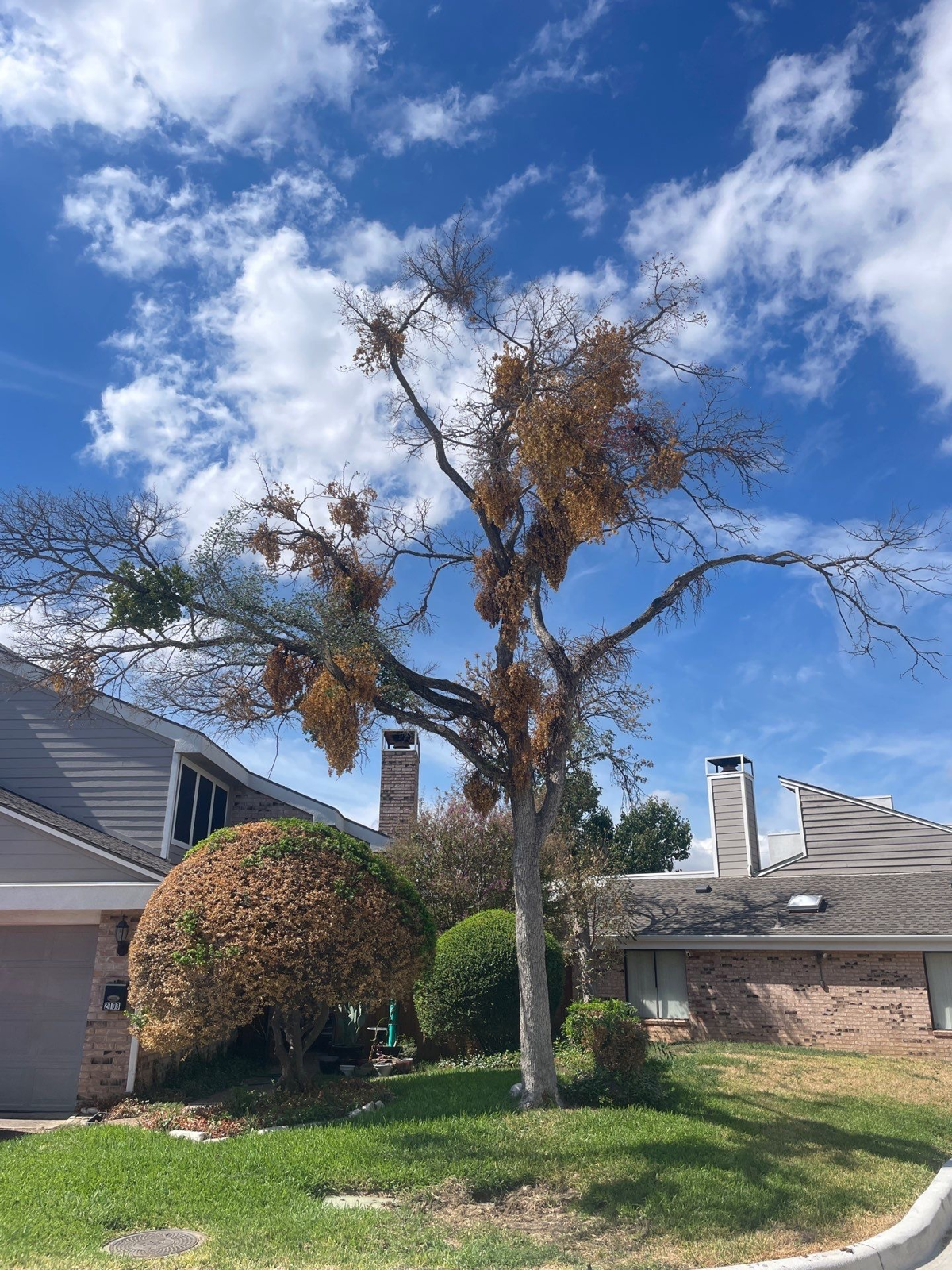
As temperatures cool and deciduous trees in Plano, Allen, Frisco, McKinney, and surrounding North Texas communities begin to lose their leaves, homeowners may notice rounded clumps of green foliage remaining in otherwise bare branches.
Those clusters are often mistletoe. Although it is familiar as a holiday decoration, mistletoe is also a living plant that takes water and minerals from the tree on which it grows. A few clusters do not automatically mean a tree is in trouble, but a substantial infestation can create additional stress. [1]
At Plano Tree Care, we believe that the right tree-care decision starts with an assessment—not an assumption that every visible cluster must be removed.
What Is Mistletoe, and How Does It Grow in Trees?
Mistletoe is an evergreen flowering plant that grows attached to a host tree. The leafy mistletoes common on Texas hardwoods are hemiparasites: they produce much of their own food through photosynthesis, but use specialized internal structures called haustoria to obtain water and mineral nutrients from their host. [1] [2]
In Texas, mistletoe can grow on species including oaks, elms, and sugarberry or hackberry relatives. Birds help spread mistletoe by transporting its sticky seeds from one tree or branch to another. [2]
Because mistletoe remains green when many host trees drop their leaves, late fall and winter are particularly useful times to spot it.
Does Mistletoe Actually Harm a Tree?
It can—but the amount of mistletoe and the condition of the host tree matter. A healthy, established tree may tolerate a small infestation for years. Heavier infestations draw more resources from the tree and can contribute to reduced vigor, branch dieback, and overall decline, particularly when other stress factors are already present. [1] [3]
Some common concerns include:
- Water stress: Mistletoe removes water from its host, which can add pressure during dry conditions.
- Weakened branches: Heavily affected portions of a canopy may show reduced growth or dieback.
- Compounding tree stress: Drought, root damage, poor soil conditions, or previous storm injury can influence how well a tree tolerates an infestation.
- Long-term canopy impacts: Extensive infestations can complicate decisions about pruning and preserving healthy branch structure.
Important: Seeing mistletoe does not establish that it caused every dead or declining branch. An arborist should evaluate the tree as a whole before identifying a cause or recommending treatment.
Why Pulling Off the Green Growth Is Not a Permanent Solution
It is tempting to think that simply cutting or pulling off the visible greenery solves the problem. However, mistletoe's internal haustorial structures may remain embedded in the host branch after the external plant has been removed.
That means visible mistletoe can grow back. Cutting away its aboveground growth may reduce seed production and temporarily limit its impact, but it is not equivalent to removing the entire infection. [3]
The appropriate management approach depends on the size and position of the affected branch, the number of mistletoe plants, and the tree's overall health.
Should You Prune Every Branch with Mistletoe?
Not necessarily. Removing an infested small branch can be an effective way to eliminate a localized infection when the cut can be made properly. But mistletoe growing on a major structural limb presents a different decision. [3]
Removing large limbs solely to eliminate mistletoe can result in unnecessary loss of foliage, large pruning wounds, and long-term changes to the canopy. Excessive pruning may do more harm to the tree than a limited infestation. [4]
Depending on the tree, an arborist may recommend selective pruning, periodic suppression of visible mistletoe, continued monitoring, or additional steps to support the tree's health. There is no single treatment that is appropriate for every tree.
The goal is not to remove mistletoe at any cost. The goal is to make the best long-term decision for the tree.
What Does an Arborist Evaluate?
Before recommending mistletoe management, a professional tree assessment should consider several factors:
- Extent of infestation. Is it isolated to one or two branches, or spread throughout the canopy?
- Tree species and condition. Is the tree growing vigorously, or does it show thinning, dieback, or other health concerns?
- Branch location and size. Can affected branches be removed without sacrificing important structural limbs?
- Other environmental stress. Are drought, soil compaction, root disturbances, or previous damage contributing to decline?
- Long-term preservation. Which approach best protects the tree's health, structure, and useful life?
A thoughtful evaluation helps distinguish when intervention is warranted from when monitoring may be the better option.
Why Fall and Winter Are Ideal Times to Notice Mistletoe
As North Texas hardwoods shed their leaves, their branches become more visible. Mistletoe stands out as green, rounded growth against the bare canopy, making it easier for homeowners to identify locations that deserve closer attention.
While looking at your trees, watch for:
- Clusters of green growth attached to otherwise leafless branches.
- Multiple clusters scattered throughout one tree.
- Deadwood or declining growth near affected areas.
- Canopy thinning or other changes in tree condition.
These observations can help guide a professional assessment. Mistletoe can be evaluated throughout the year; winter simply makes it easier to see in deciduous trees.
Can Mistletoe Be Prevented from Returning?
Because birds naturally move mistletoe seeds between trees, preventing every new infection is difficult. Even after an affected branch is properly removed, mistletoe may establish itself elsewhere in the canopy in the future. [3]
Practical tree care focuses on limiting avoidable stress and monitoring changes over time. Appropriate watering during dry periods, protecting roots from construction or soil compaction, and sound pruning practices all support overall tree health.
Routine assessments can also help identify increasing mistletoe activity or other tree-health issues before they become more difficult to manage.
Healthy Trees Start with Informed Decisions
Mistletoe might be a holiday symbol, but its presence in a tree deserves more than a quick glance. A light infestation may require little more than observation. A widespread infestation, especially in a declining tree, may call for a more detailed assessment and management plan.
At Plano Tree Care, our focus is on evaluating the complete picture: tree condition, location of the infestation, structural integrity, and the potential consequences of pruning. That perspective helps protect trees from both unnecessary intervention and avoidable neglect.
This Holiday Season, Take a Look Up
Noticed mistletoe growing in your trees? Plano Tree Care can help evaluate your tree's condition and determine whether pruning, monitoring, or other care makes sense. We serve Plano, Allen, Frisco, McKinney, and surrounding North Texas communities.
Call 214-502-8375 Visit Plano Tree CareHealthy trees start with informed decisions.
Sources & Further Reading
Educational references supporting the mistletoe biology and management information in this article:
- Texas A&M Forest Service — Mistletoe . Overview of mistletoe and its effects on tree health.
- Texas A&M Forest Service — What You Need to Know About Mistletoe . Texas host species and mistletoe background.
- University of California Statewide Integrated Pest Management Program — Mistletoes . Biology, spread, pruning, and management options.
- University of California Statewide Integrated Pest Management Program — Pruning . General pruning principles and avoiding unnecessary large wounds.
This article provides general educational information, not a diagnosis of any individual tree. Site-specific management recommendations require an assessment of the tree and its growing conditions.