What Do Arborists Look for During a Tree Assessment?
A tree can look perfectly healthy from a distance while showing signs of structural weakness, competing branches, or developing root problems. Other trees may look concerning but simply be responding to seasonal changes or normal growth.
So how do you know the difference?
At Plano Tree Care, Inc., we look beyond a tree's appearance to evaluate its structure, growth patterns, and overall condition. With ISA Certified Arborist expertise, we examine how branches attach, where limbs cross or compete, and whether the roots and surrounding soil may be affecting the tree's long-term health.
The goal isn't simply to find something wrong. It's to understand what we're seeing, determine what it means, and help property owners make informed decisions about their trees.
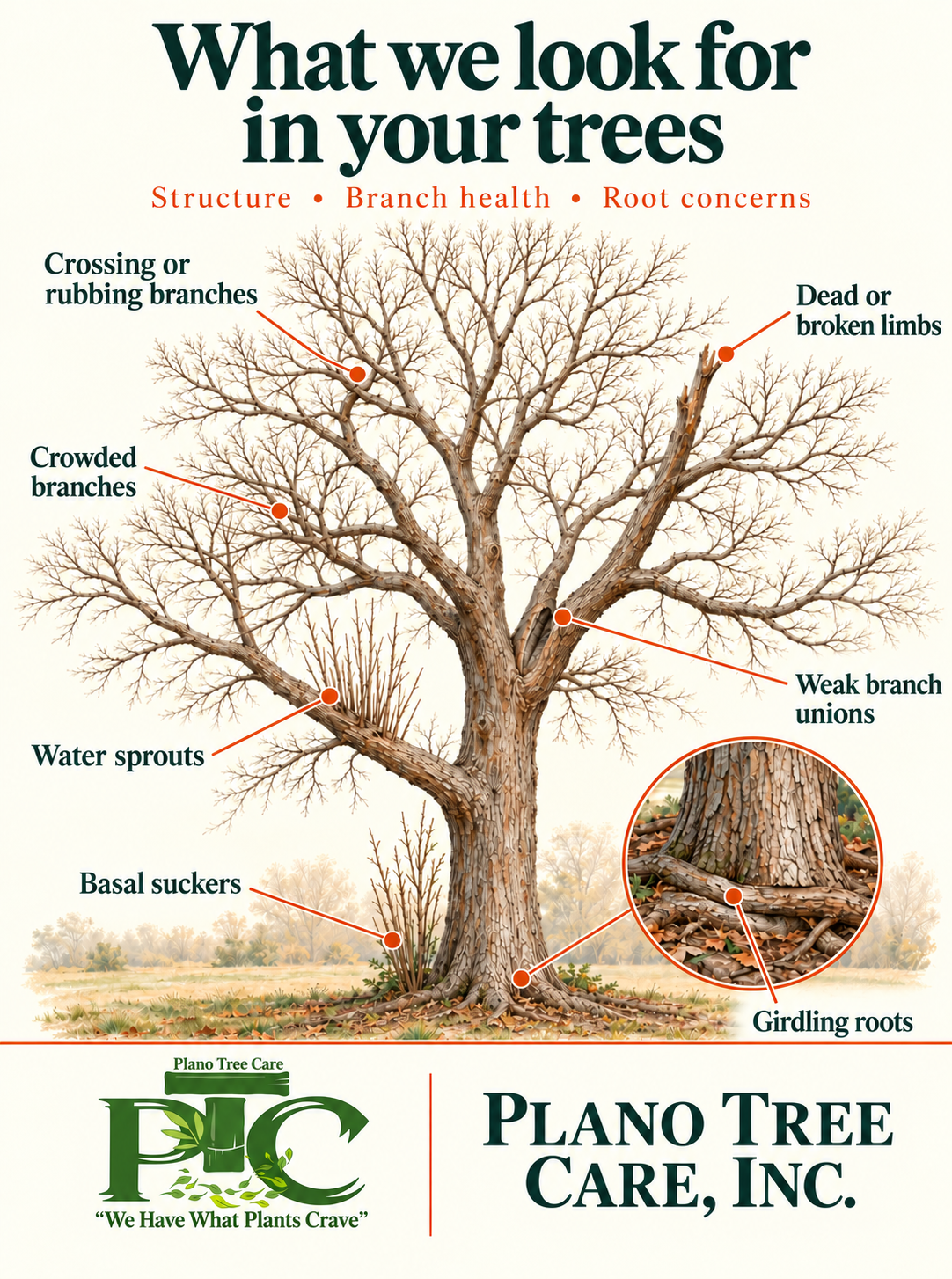
Seven Things We Look for During a Tree Assessment
Every tree is different. Its species, age, location, previous maintenance, and exposure to North Texas weather all influence how it grows and responds to stress.
According to the International Society of Arboriculture (ISA), proper pruning requires an understanding of tree biology because improper cuts can create lasting damage or shorten a tree's life.
Here are seven characteristics we evaluate when assessing a tree.
1. Crossing or Rubbing Branches
As a tree grows, branches can cross paths and begin rubbing against one another.
Over time, that friction can damage bark, create wounds, and expose underlying wood to additional damage.
However, not every crossing branch requires removal.
Our arborists evaluate the size, location, and condition of the affected branches before determining whether selective tree pruning would benefit the tree.
What we're assessing: Whether branch contact is causing damage or creating a structural concern that may worsen with continued growth.
2. Crowded Branches
A dense canopy isn't necessarily an unhealthy canopy. In fact, a full canopy can be a sign of vigorous growth.
But when branches compete for space, overlap excessively, or develop undesirable growth patterns, selective pruning may help improve the tree's structure.
The key is knowing what to remove and, equally important, what to leave alone.
Excessive pruning can reduce the leaf area a tree needs to produce energy and may trigger undesirable regrowth.
ISA guidance emphasizes that pruning should have a specific objective. Removing branches simply to thin a canopy may not provide a meaningful benefit.
What we're assessing: Branch spacing, growth direction, structural balance, and whether pruning would provide a meaningful benefit.
3. Dead or Broken Limbs
Dead, damaged, or broken branches deserve attention, particularly when located above homes, driveways, sidewalks, or areas where people regularly gather.
These branches may result from storm damage, disease, insect activity, environmental stress, or natural branch decline.
A dead branch does not automatically mean the entire tree is unhealthy. However, its location, size, and condition can influence whether corrective action is appropriate.
The ISA's tree risk guidance explains that appropriate responses may include pruning, routine care, additional support, or removal, depending on the circumstances.
After severe weather, damaged branches may also require a professional storm damage evaluation .
What we're assessing: The extent of damage, potential for branch failure, and whether surrounding structures or people could be affected.
4. Weak Branch Unions
One of the most important parts of a structural tree assessment is examining how branches connect to the trunk and to one another.
Some trees develop narrow branch attachments, competing stems, or included bark between growing stems. Certain configurations can create weaker connections as branches grow larger and heavier.
These conditions deserve closer evaluation, especially on mature trees exposed to strong winds and thunderstorms.
Not every narrow branch angle is dangerous. An arborist considers the species, attachment characteristics, branch size, visible defects, and surrounding conditions before recommending a course of action.
Depending on the findings, recommendations might involve monitoring, structural pruning, further risk assessment, or supplemental support systems where appropriate.
What we're assessing: The structural integrity of branch attachments and whether additional evaluation, corrective pruning, support, or monitoring is appropriate.
5. Water Sprouts
Water sprouts are vigorous, often upright shoots that develop along a tree's trunk or existing branches.
They can appear following heavy pruning, storm damage, increased sunlight exposure, or other changes in growing conditions.
Water sprouts aren't automatically a sign of disease. However, their location, density, and attachment characteristics may warrant attention.
In some cases, selective management can improve branch structure and help avoid future maintenance concerns.
Large numbers of sprouts after aggressive pruning can also demonstrate why responsible pruning practices matter.
What we're assessing: Why the shoots developed, how they're attached, and whether their growth is contributing to structural problems.
6. Basal Suckers
Basal suckers are new shoots that emerge near the base of a tree or from its root system.
Some tree species naturally produce these shoots, while others may develop them in response to stress, injury, or changes in growing conditions.
Simply removing the visible growth doesn't necessarily address the underlying cause.
Our arborists consider the species, overall tree condition, and surrounding root environment when determining whether basal sucker growth requires attention.
What we're assessing: Whether the growth is characteristic of the species or may indicate another condition that warrants investigation.
7. Girdling Roots
Some of the most important concerns affecting a tree are found at or below the soil surface.
Girdling roots develop when roots grow around or press against the trunk or other major roots rather than extending outward normally.
As the tree grows, certain girdling roots can compress trunk tissues and interfere with normal water and nutrient movement.
Possible warning signs include abnormal swelling, a lack of visible root flare, reduced growth, and canopy decline. However, these symptoms can have multiple causes and require proper evaluation.
The University of Minnesota Extension identifies trunk compression, abnormal root flare development, reduced growth, and canopy symptoms as possible indicators of stem-girdling roots.
In some situations, an arborist may recommend carefully exposing the root flare or investigating the root system to determine the extent of the concern.
Importantly, removing a large root without understanding its function can cause additional damage or compromise tree stability.
Root-related symptoms may also justify a broader plant health care evaluation to better understand growing conditions and other factors affecting the tree.
What we're assessing: Root growth patterns, trunk compression, soil conditions, and whether the root system is affecting the tree's health or stability.
Identifying a Concern Is Not the Same as Diagnosing a Problem
This is an important distinction.
A crossing branch, water sprout, or exposed root provides information about a tree. But an individual observation rarely tells the whole story.
For example:
- A tree with crowded branches may benefit from selective pruning, or its existing canopy may be appropriate for its species.
- A weak-looking branch attachment may need further evaluation rather than immediate removal.
- A tree with exposed roots may be growing normally, while a nearby girdling root could be creating a problem.
- A declining branch may be the result of localized damage rather than a problem affecting the entire tree.
Finding an issue doesn't automatically mean a tree needs treatment.
The objective is to understand the tree's condition before deciding what, if any, action is appropriate.
Understanding these differences requires looking at the whole tree and its surroundings. That's why a professional assessment focuses on both visible symptoms and the conditions that may be contributing to them.
Why Tree Assessments Matter in North Texas
Trees throughout Plano, Allen, Frisco, McKinney, Richardson, and surrounding North Texas communities face changing environmental conditions.
Extended periods of heat, drought stress, compacted soils, changing moisture levels, and severe storms can all affect tree health and structural condition.
Sometimes the effects are obvious, such as broken limbs following a thunderstorm. Other times, changes develop gradually and may not be recognized until a tree begins showing visible decline.
A professional assessment can help establish a clearer picture of the tree's current condition and identify concerns worth addressing or monitoring.
It also gives property owners an opportunity to plan maintenance rather than making every decision in response to an urgent situation.
If trees are showing signs of environmental stress, our North Texas plant health care services can help evaluate potential contributing conditions and appropriate care options.
Does Every Tree Concern Require Immediate Action?
No. And that's one of the most important things homeowners should understand.
Finding an issue doesn't automatically mean a tree needs to be pruned, treated, or removed.
Depending on the situation, an appropriate recommendation might include:
- Monitoring: Observing a condition over time to determine whether it changes.
- Selective pruning: Addressing particular branches to improve structure or reduce an identified concern.
- Further investigation: Examining the roots, trunk, or canopy more closely before making a recommendation.
- Plant health care: Evaluating soil conditions, nutrition, pests, or disease when symptoms suggest a health concern.
- Corrective action: Addressing a specific structural or safety issue when the evidence supports intervention.
- No immediate treatment: Leaving a healthy tree alone when additional work would provide little or no benefit.
The objective is to recommend what is appropriate for the tree, not simply what can be done to it.
The International Society of Arboriculture's guidance on managing tree risk recognizes that different conditions may require different responses, including routine care, pruning, supplemental support, changes to the surrounding area, or removal.
If a tree presents an immediate hazard, such as a newly split trunk or hanging storm-damaged limb over an occupied area, keep people away and seek professional help rather than waiting for a routine inspection.
Our Approach: Assess, Diagnose, Educate, Execute
At Plano Tree Care, we believe responsible tree care begins with understanding.
1. Assess
Examine the tree's condition, structure,
growth patterns, and surrounding environment.
2. Diagnose
Evaluate the findings to determine whether
they indicate a problem, a potential concern,
or normal tree development.
3. Educate
Explain what we found, why it matters,
and what options are available, including
continued monitoring when appropriate.
4. Execute
Implement the agreed-upon care plan
when action is necessary.
This approach helps property owners understand not only what we're recommending, but why we're recommending it.
And sometimes, the best recommendation is to let the tree continue growing naturally.
Know More About Your Trees Before Making a Decision
Trees are valuable parts of our North Texas landscapes. They provide shade, contribute to property appeal, and can remain part of a property for generations when growing conditions are favorable.
Understanding their condition is an important part of caring for them responsibly.
Whether you're concerned about a particular branch, noticing unusual growth, or simply want a better understanding of your trees, a professional assessment can provide useful information about their current condition and potential needs.
You don't need to wait until there's an obvious problem to understand what's happening with your trees.
At Plano Tree Care, Inc., we believe in educating property owners first so they can make confident, informed decisions about their tree care.
Educate First. Sell Second.
Our responsibility is to explain what we're seeing, what it means, and what options are appropriate for your trees.
Schedule a Professional Tree Assessment
Plano Tree Care, Inc. has served North Texas for more than 30 years, providing tree evaluations, professional pruning, tree removal, and plant health care.
Have questions about a tree on your property? Let us help you understand its condition and explore your options.
Call 214-502-8375 Explore Our Tree Services
Plano Tree Care, Inc.
We Have What Plants Crave.
References and Additional Reading
The following professional and educational resources provide additional information about pruning, tree risk assessment, and root-related concerns.
- International Society of Arboriculture (ISA) — Pruning Trees. Guidance on pruning objectives, techniques, tree structure, and avoiding harmful pruning practices. Read ISA Pruning Guidance
- International Society of Arboriculture (ISA) — Managing Hazards and Risk. Guidance on recognizing potential tree hazards and evaluating appropriate risk-management options. Read ISA Tree Risk Guidance
- University of Minnesota Extension — Plant Diagnostics: Ash Trunk and Branch Problems. Educational information on symptoms associated with stem-girdling roots, environmental stress, and tree decline. Read University of Minnesota Extension
- International Society of Arboriculture (ISA) — Tree Owner Resources. Educational resources on pruning, plant health care, mature tree management, and tree risk assessment. Explore Tree Owner Resources
Educational note: The information in this article is intended to help property owners recognize common tree conditions. It is not a substitute for an on-site assessment. Tree health and structural risk depend on the individual tree, its environment, and the conditions observed during professional evaluation.