
Raising a Tree Canopy Is About More Than Creating Clearance
Tree canopy raising may seem like a straightforward solution when lower branches begin interfering with vehicles, pedestrians, buildings, signs, parking areas, or visibility.
But proper canopy raising is about more than simply removing the lowest branches.
The objective is to create the clearance the property needs while preserving as much healthy, functional canopy as possible.
Creating Clearance Without Sacrificing the Tree
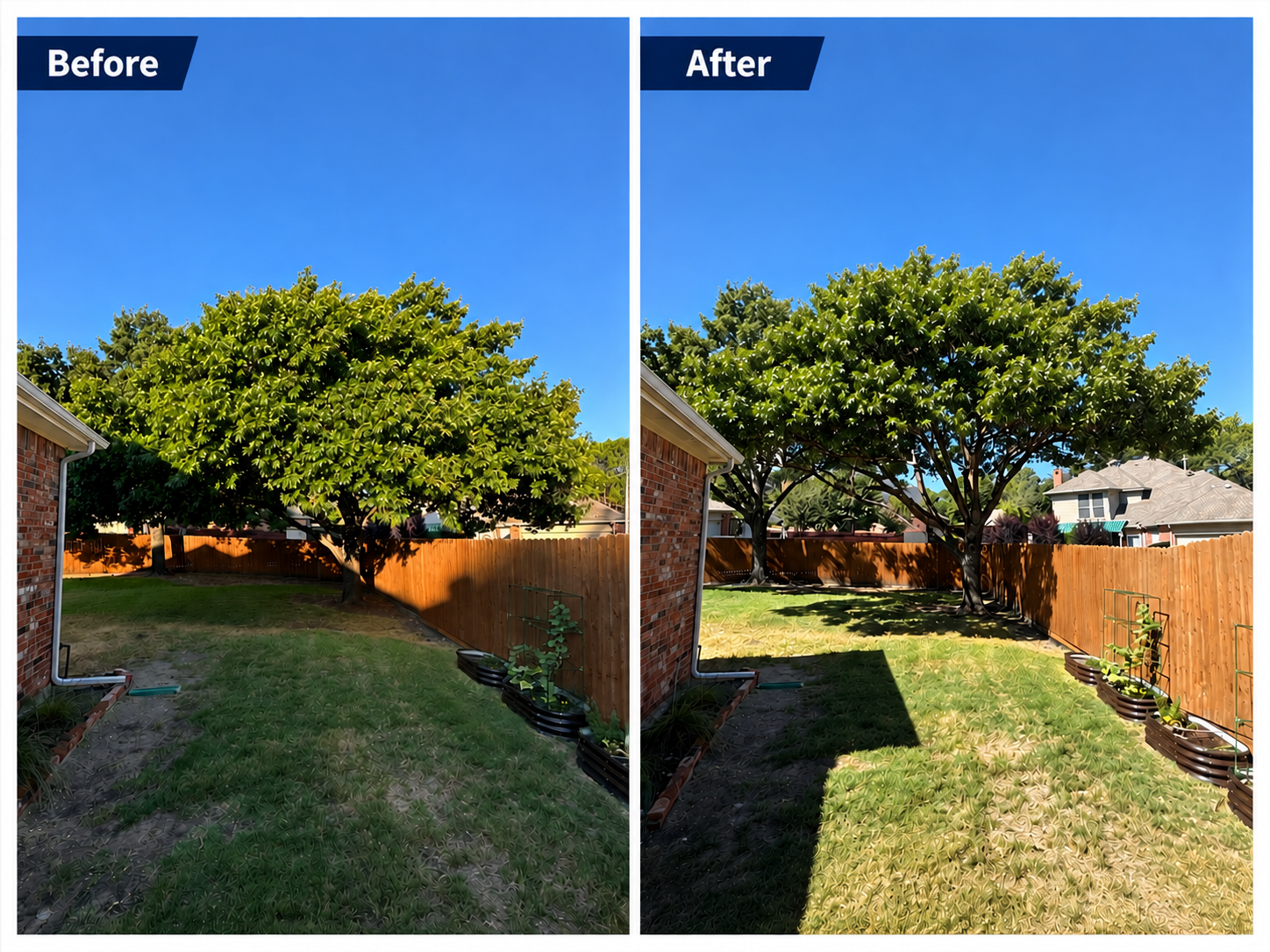
For this red oak, the lower canopy was raised to approximately 15 feet.
The difference is easy to see in the before-and-after photos. The area beneath the tree is more open, clearance has been improved, and the tree has a cleaner appearance.
But appearance was not the primary goal.
The pruning was approached with the tree’s structure, natural shape, and overall canopy balance in mind.
Rather than removing branches simply because they were low, the goal was to identify what needed to be removed to achieve the necessary clearance while retaining healthy live canopy wherever possible.
That distinction matters.
Every live branch contributes to the tree. Removing more canopy than necessary can place additional stress on the tree and change how weight is distributed throughout the crown.
Good tree trimming and pruning should solve the problem without creating another one.
What Arborists Look at Before Raising a Canopy
Tree canopy raising should begin with an assessment of the entire tree, not just the branches creating the immediate conflict.
An arborist may consider:
- How much clearance is actually needed
- The size and location of the branches involved
- The tree’s natural growth habit
- Overall canopy balance
- Branch attachment and structural condition
- Dead, damaged, or poorly attached limbs
- Existing stress or decline
- How the tree may respond to the proposed pruning
The answer is not always to remove every branch below a predetermined height.
Sometimes accomplishing the objective means selecting a smaller number of branches carefully so the tree continues to maintain a natural, balanced crown.
Property managers, HOAs, retail centers, office properties, and other managed sites may have additional clearance and safety considerations. Plano Tree Care’s Commercial Division provides pruning and tree-care services specifically for those types of properties.
Canopy Raising and Storm Preparation
Thoughtful pruning can also play a role in preparing trees for North Texas severe weather.
High winds and storms can expose weaknesses that may already exist within a tree. Dead branches, damaged limbs, poor attachments, or other structural concerns can become more significant when the canopy is placed under additional wind load.
Identifying those conditions before severe weather arrives provides an opportunity to address potential problems proactively.
However, pruning does not make a tree storm-proof.
Healthy trees can still lose limbs during severe weather, and extreme winds can damage even structurally sound trees.
The goal is risk reduction, not a guarantee.
That is another reason indiscriminate or excessive pruning is not the answer. Removing too much live canopy simply in the name of storm preparation can unnecessarily stress the tree.
Plano Tree Care provides a range of tree services for North Texas properties , including pruning, storm-damage response, tree removal, plant health care, and clearance work.
The Before-and-After Is Only Part of the Story
The visual difference after canopy raising can be dramatic.
There is more clearance. The property looks cleaner. Sight lines may improve. Vehicles and pedestrians have more room beneath the canopy.
But successful pruning should not be judged only by how much was removed.
It should also be judged by what was intentionally left behind.
For this red oak, the objective was to achieve approximately 15 feet of clearance while preserving the tree’s natural shape and maintaining a healthy, balanced canopy.
That is the difference between simply cutting branches and managing a tree.
Assess. Diagnose. Educate. Execute.
At Plano Tree Care, pruning begins with understanding what the tree and the property actually need.
We assess the tree and the surrounding environment, identify structural concerns and conflicts, determine the appropriate pruning objective, and then perform the work with the long-term health and structure of the tree in mind.
Because sometimes the best pruning decision is not about how much you can remove.
It is knowing how much you should leave.
Does Your Tree Need More Clearance?
If you have a tree that needs clearance, structural pruning, or an evaluation before severe weather, Plano Tree Care can assess the tree and recommend the appropriate next step.
Request a Free EstimatePlano Tree Care has been serving North Texas for more than 30 years, providing professional tree care for residential and commercial properties throughout the region.