
Brown Leaves in Summer: What Severe Heat Stress Can Do to a North Texas Tree
A tree can go from showing a few signs of stress to having a completely brown canopy faster than many homeowners expect.
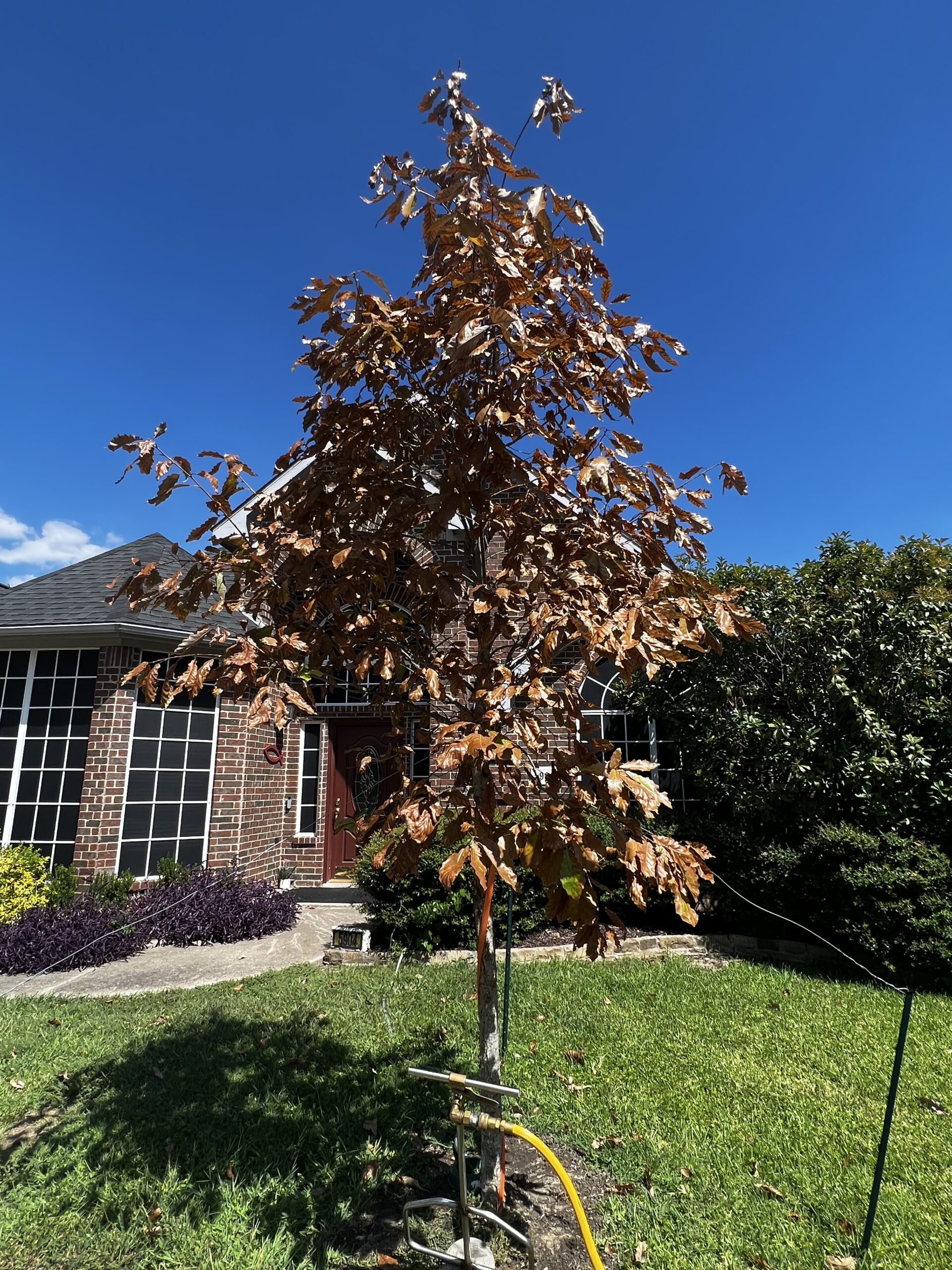
At this North Texas property, nearly all the leaves on this young tree had turned brown. The foliage was dry, curled and still attached throughout much of the canopy. With prolonged summer heat and limited moisture reaching the roots, water stress was one of the first concerns.
However, brown leaves are a symptom, not a complete diagnosis.
Before recommending treatment, additional watering or removal, it is important to assess the tree, the soil and the surrounding conditions.
What We Saw in the Canopy
The most visible problem was the widespread browning across the tree.
Instead of the damage appearing on only one branch or in one section of the canopy, the decline affected nearly the entire tree. Very little healthy green foliage remained.
Common warning signs of heat and water stress can include:
- Wilting or curling leaves
- Browning along the edges of leaves
- Premature leaf drop
- A thinning canopy
- Dry or brittle foliage
- Reduced seasonal growth
These symptoms can develop when a tree loses moisture faster than its roots can replace it.
Drought can also damage the fine feeder roots responsible for absorbing water and nutrients. According to the Texas A&M Forest Service, drought-related root damage can continue affecting a tree even after moisture returns to the soil.
Brown Leaves Do Not Always Mean the Same Thing
Heat and insufficient moisture were major concerns in this situation, but it would be irresponsible to assume that watering is always the complete answer.
Similar symptoms can also be associated with:
- Excessive watering or poor drainage
- Root damage
- Compacted soil
- Improper planting depth
- Transplant stress
- Herbicide exposure
- Insect activity
- Vascular or root disease
Some diseases can closely resemble drought damage. For example, bacterial leaf scorch can cause premature browning and a scorched appearance that may be mistaken for ordinary water stress.
This is why Plano Tree Care begins by looking at the entire situation rather than diagnosing a tree from leaf color alone.
Why Lawn Sprinklers May Not Be Enough
A lawn can appear green while a nearby tree is still struggling for moisture.
Short sprinkler cycles are designed primarily for turfgrass. They may wet the upper surface of the soil without providing enough sustained moisture throughout the tree’s active root zone.
Tree roots also extend beyond the area immediately beside the trunk. Concentrating water only at the base can leave much of the root system dry.
During hot, dry conditions, water should generally be applied slowly enough to soak into the soil rather than running across the lawn. The application should cover the broader root zone and be adjusted according to the tree’s age, soil conditions, drainage and recent rainfall.
Read more in our North Texas summer tree-care guide and our essential guide to watering healthy trees.
Developing a Slow, Deep Watering Plan
After assessing the canopy and the conditions surrounding the tree, a slow, deep watering plan was established around the root zone.
The goal was not to flood the soil. It was to give the moisture enough time to penetrate below the surface and reach the roots while avoiding excessive runoff.
The Texas A&M Forest Service recommends checking soil moisture before watering instead of relying only on a fixed calendar.
One simple method is to test whether a screwdriver can be pushed approximately 6 to 8 inches into the ground. Soil that is too dry may be difficult to penetrate.
The appropriate watering frequency can depend on:
- The age and size of the tree
- Soil type and compaction
- Drainage around the planting area
- Recent rainfall
- Sun exposure
- Current temperatures
- Existing root damage or disease
Young and recently planted trees may need attention more frequently than established trees because their root systems have not yet expanded throughout the surrounding soil.
More Water Is Not Always Better
Once a tree turns brown, the natural reaction is often to water it as much as possible.
That can create another problem.
Oversaturated soil contains less oxygen, which can place additional stress on the roots. A tree experiencing poor drainage or root decline may become worse if water is repeatedly added without first checking the soil.
Fertilizer should not automatically be applied either. Fertilization may encourage new growth at a time when the tree needs to conserve energy. Fertilizer should be based on the tree’s condition and an identified need, not used as an automatic response to brown leaves.
Will a Completely Brown Tree Recover?
A tree with this much canopy damage should be monitored closely, and recovery cannot be guaranteed.
The existing brown leaves will not return to green. The more important questions are whether the branches, buds, trunk and root system still contain enough living tissue to support future growth.
A follow-up assessment may include checking:
- Whether smaller branches remain flexible
- Whether viable buds are present
- Whether tissue beneath the bark is still alive
- Whether soil moisture improves after watering
- Whether the tree continues to decline
- Whether insects, disease or root problems become visible
Immediate removal is not always necessary, but neither should a severely stressed tree be assumed to be recovering simply because it has been watered.
Follow-up observation is an important part of the process.
Catching Tree Stress Early Creates More Options
The earlier heat and water stress are identified, the more opportunities there may be to correct the underlying condition.
Sometimes the solution is improved watering. In other cases, the tree may need soil support, pest or disease management, corrective planting work, continued monitoring or eventual replacement.
Plano Tree Care evaluates the tree and its surrounding conditions before recommending the next step. Our plant health care services are based on the tree species, visible symptoms, soil conditions and seasonal pressures affecting the property.
Is a Tree on Your Property Turning Brown?
If a tree on your property is wilting, dropping leaves or turning brown, do not wait until the entire canopy is affected.
Plano Tree Care Inc. can assess the tree, the root zone and the surrounding conditions to help determine the appropriate next step.
Call 214-502-8375 or request a free tree-service estimate online.