
Why a Missing Root Flare Can Signal Girdling Roots
Girdling roots can develop below the ground, where homeowners cannot easily see them.
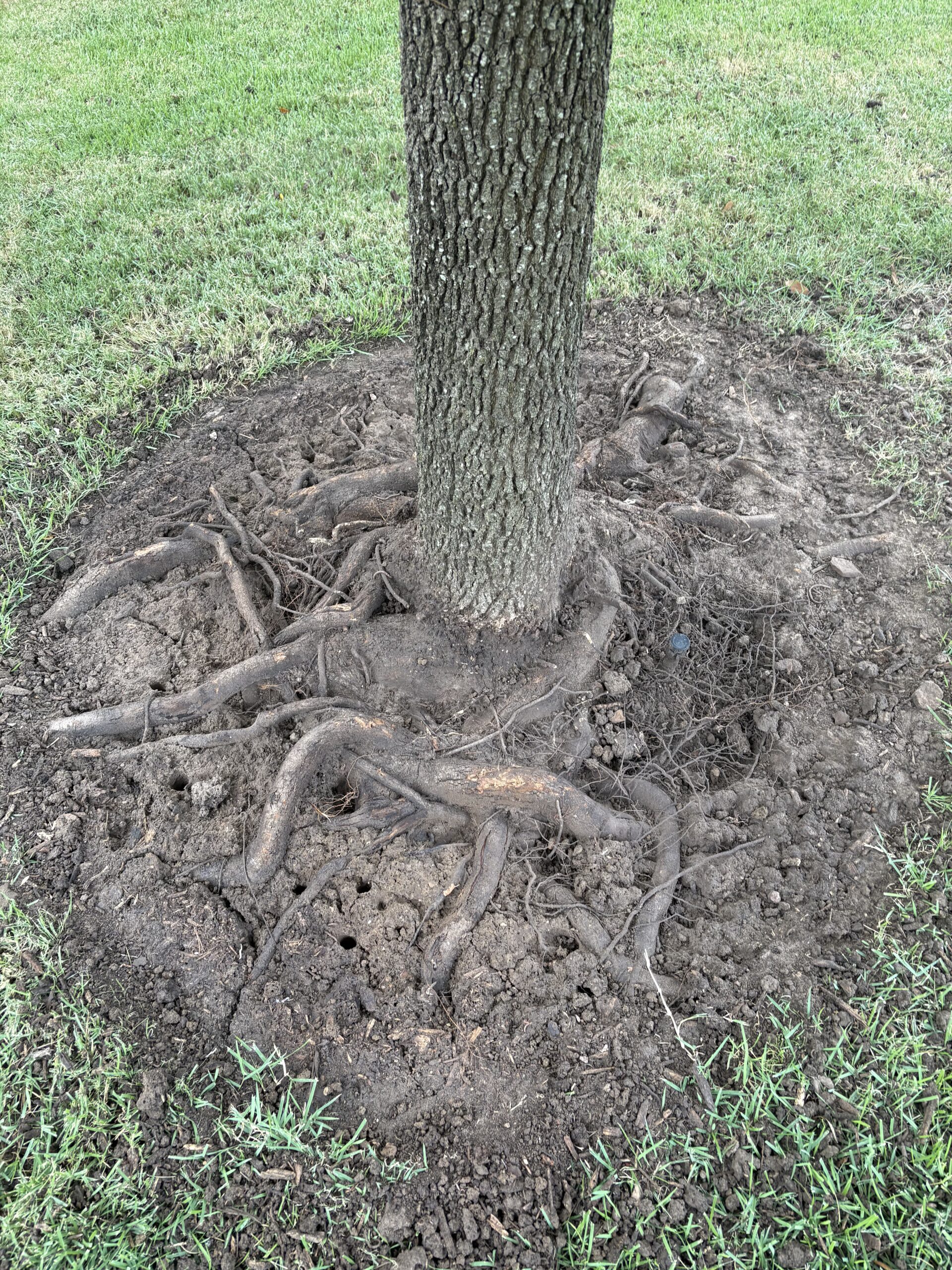
At a recent North Texas jobsite, the Plano Tree Care team evaluated a live oak with very little visible root flare. Instead of widening naturally where the trunk met the ground, the tree looked more like a straight pole entering the soil.
After carefully exposing the root zone, we found roots crossing and pressing against the trunk rather than growing outward. These are commonly called girdling roots.
Girdling roots in live oak trees can remain hidden for years, especially when the tree’s natural root flare is buried beneath soil or mulch. As the roots and trunk increase in diameter, the pressure between them can restrict normal development and contribute to long-term tree decline.
What is a tree’s root flare?
The root flare, sometimes called the trunk flare or root collar, is the area at the base of a tree where the trunk begins to widen and transition into the tree’s major structural roots.
On a properly planted and developing tree, this widening should generally be visible at or near the soil line. The base of the tree should not resemble a telephone pole disappearing straight into the ground.
The University of Minnesota Extension recommends locating the root flare and keeping it visible. Planting a tree too deeply or allowing soil and mulch to accumulate around the trunk can bury the flare and create conditions associated with circling or girdling roots.
A missing root flare does not automatically prove that girdling roots are present. However, it is an important warning sign. The flare may be hidden beneath excess soil or mulch, the tree may have been planted too deeply, or problematic roots may be developing below the surface.
What are girdling roots?
Most healthy tree roots extend away from the trunk and into the surrounding soil.
Girdling roots grow across, around or directly against the base of the trunk. Some may partially circle the trunk, while others press against one side of it.
As the tree and roots grow, the contact between them can become tighter. This pressure may interfere with the movement of water and nutrients through the affected portion of the tree.
Possible signs associated with girdling roots include:
- Slow or uneven growth
- Thinning foliage
- Poor canopy color
- Early leaf drop
- Branch decline or dieback
- Compression or flattening near the base of the trunk
- A trunk that enters the soil without a visible flare
- Visible roots circling or pressing against the trunk
The University of Minnesota Extension’s oak diagnostic guidance identifies a missing trunk flare, trunk compression and visible roots circling the trunk as possible signs of stem-girdling roots.
These symptoms are not exclusive to girdling roots. Drought, disease, soil compaction, drainage problems, construction damage and other environmental conditions can produce similar symptoms.
For that reason, the appearance of the canopy alone should not be used to diagnose a root problem. The tree, trunk base and surrounding root zone should be properly evaluated.
Why do girdling roots develop in live oak trees?
Girdling roots often begin while a tree is still young, although the resulting symptoms may not become noticeable until years later.
The tree was planted too deeply
When a tree’s root flare is installed below the surrounding soil level, the trunk and upper root system begin their development beneath the soil.
Roots may then grow toward or around the buried trunk instead of extending normally into the surrounding soil. The tree may appear healthy for an extended period before the consequences become visible above ground.
Plano Tree Care’s guide to proper tree planting in North Texas explains why correct planting depth and visible root-flare placement are important for long-term tree health.
The tree remained in a nursery container too long
Roots growing inside a nursery container can begin circling the outside of the root ball when they run out of space.
If those roots are not identified and corrected during planting, they may continue following a circular growth pattern. As the tree matures, some of those roots can press against the trunk or larger structural roots.
The University of Maryland Extension recommends loosening and straightening circling roots during planting, because container-grown and pot-bound trees frequently develop girdling roots.
Excess soil or mulch was added around the trunk
Adding soil around an established tree or repeatedly piling mulch against the trunk can gradually bury a root flare that was originally visible.
This can conceal developing root problems and change the moisture and oxygen conditions around the trunk and upper root system.
Mulch should be spread outward around the tree rather than piled against the trunk in a “mulch volcano.” The root flare should remain visible, and the mulch should not directly contact the tree’s bark.
The University of Minnesota Extension’s tree-planting guidance recommends creating a broad mulch ring while keeping mulch away from the trunk.
How we exposed the problem
Before corrective work could be considered, our team needed to see what was happening beneath the soil.
We carefully excavated the root zone by hand and with an air spade. An air spade uses compressed air to move soil away from the base of the tree, allowing the root collar and upper root system to be inspected without relying on aggressive mechanical digging around the trunk.
The University of Maryland Extension describes air-spade root-collar excavation as a method arborists can use to remove excess soil while causing minimal disturbance to the roots.
Once the root zone was visible, our team could identify which roots were crossing or pressing against the trunk and evaluate how they were affecting the tree.
Plano Tree Care offers air-spading, root-zone work and Plant Health Care services when soil, root-zone or overall tree-health conditions need professional evaluation.
Why not every exposed root should be removed
Exposing a crossing root does not automatically mean that the root should be cut.
Roots help anchor the tree and absorb water and nutrients. Removing the wrong root—or removing too much of the root system—can create additional health or stability concerns.
Corrective root-pruning decisions should consider:
- The size of the root
- Where the root contacts the trunk
- How deeply the root is embedded
- Whether the root provides significant structural support
- The condition of the trunk beneath the root
- The tree’s age, health and overall stability
- The amount of healthy root system that would remain
The University of Maryland Extension recommends consulting a qualified arborist before removing large girdling roots, because removing a large or deeply embedded root is a more involved process and may affect the tree’s health or stability.
Homeowners should not begin cutting major roots simply because they appear to cross one another.
How the girdling roots were addressed
After evaluating the exposed root system at this jobsite, our team selectively removed the girdling roots that were pressing into the trunk and could be addressed without unnecessarily removing healthy portions of the root system.
The goal was not to cut every crossing or exposed root. It was to address the specific roots contributing to the problem while preserving as much of the functional root system as possible.
Corrective root work does not guarantee that every affected tree will recover. The potential outcome depends on factors including:
- How long the roots have been constricting the trunk
- The size and location of the girdling roots
- The tree’s age and overall condition
- The amount of existing trunk or root damage
- The importance of the affected roots to tree stability
- Soil and drainage conditions
- Watering and follow-up care
- Other environmental stresses affecting the tree
Early identification may provide an arborist with more management options than waiting until the tree has experienced advanced canopy decline.
What homeowners should look for
Walk outside and look closely at the base of your trees.
A healthy tree base should generally widen before the major roots enter the soil. Consider requesting a professional evaluation when:
- The trunk disappears straight into the soil
- The root flare is completely hidden
- Soil or mulch is piled against the trunk
- Roots are visibly circling or pressing against the trunk
- One side of the trunk appears compressed or flattened
- The canopy is thinning without an obvious explanation
- The tree shows slow or uneven growth
- The tree consistently loses leaves earlier than comparable nearby trees
- Branches are declining or dying back
These signs do not provide a complete diagnosis, but they may indicate that a closer inspection is warranted.
Do not remove large roots without understanding how the work could affect the health or stability of the tree. An ISA Certified Arborist or other appropriately qualified tree-care professional should evaluate the root system before significant roots are removed.
Give your tree a better chance at long-term health
Live oaks are an important part of many North Texas landscapes, but they are not immune to problems caused by improper planting, buried root flares and restricted root development.
A tree can live with a buried root flare or girdling roots for years before the damage becomes obvious above ground. By the time significant canopy decline appears, the condition may be more difficult to manage.
If the base of your tree looks more like a straight pole than a natural flare, Plano Tree Care can evaluate the tree, carefully expose the root zone when appropriate and explain the available next steps.
Concerned about your tree’s root flare?
Schedule a professional tree-health evaluation with Plano Tree Care.
Call 214-502-8375 or request an evaluation online.
Request a Free EstimateFrequently asked questions about live oak girdling roots
What should the base of a healthy tree look like?
The trunk should generally widen as it reaches the ground and transitions into the tree’s major structural roots. This widening is called the root flare. A trunk that enters the ground without widening may have a buried root flare or another condition that warrants closer inspection.
Can girdling roots kill a tree?
Severe girdling roots can contribute to long-term decline and may eventually lead to the death of an affected tree. The outcome depends on the roots’ size, location and severity, as well as the tree’s age, condition and surrounding environment.
Should I cut girdling roots myself?
Large or significant roots should not be removed without a professional evaluation. Cutting an important absorbing or structural root can damage the tree and may affect its stability.
Why is my live oak’s root flare buried?
Common causes include planting the tree too deeply, adding excess soil around the trunk, repeatedly piling mulch against the tree or planting a tree with a poorly developed or circling root system.
Does a missing root flare prove that the tree has girdling roots?
No. A missing root flare is a warning sign, not a complete diagnosis. The flare may be buried beneath soil or mulch even when no serious girdling roots are present. The root zone must be carefully exposed and evaluated to determine what is happening.
Can an older tree with girdling roots be treated?
Some mature trees may benefit from corrective work, but treatment depends on the size and location of the roots, the amount of trunk damage and the tree’s overall condition. Some roots may be too large or too deeply embedded to remove safely.
What is air-spade root excavation?
Air-spade excavation uses compressed air to move soil away from the base of a tree. This allows the root flare and upper root system to be inspected with less disturbance than aggressive mechanical excavation.
Will removing girdling roots guarantee that the tree recovers?
No. Removing an appropriate girdling root may reduce continued pressure on the trunk, but recovery depends on the severity and duration of the damage, the condition of the remaining root system and other environmental stresses affecting the tree.